Tom Milwee on September 17, 2023 presentation at the Longwood Historic Society member meeting and potluck at the Historic Civic Center in Longwood, Florida.
🎙️ Tom Milwee: Historic Longwood (Transcript)
Introduction and History
Before I begin this afternoon, I would like to thank Tom and Pam for inviting us to your program. We’ve been really looking forward to doing this, actually. We’ve been talking about Longwood off and on for many times, talk about how it’s changed and memory of the past. But this gives us a chance to kind of brag about it and tell you what type of City you had back in let’s say the 50s to the 60s and 70s.
This talk is not going to be about buildings. It’s not going to be about how old they are or what was in them. I’m solely going to talk about it, we’re slowly going to talk about the community and the people that inhabited Longwood. The ones that are buried over in the Longwood Cemetery. I have to admit that about 98% of them are over there right now, so whatever we say nobody’s getting dispute. And I like talking to Cassidy my wife Judy, I said you know it’s kind of like a little gossip session we’re going to have. We’ll let you know the nice warm people that live in this community during this period of time.
First of all, a little bit going back, a little bit of History. In 1950, there were 717 people living in the city of Longwood. Then it grew in 1960 to 1,600. Today Longwood has about 16,000. So you can see over that period of time how this place has grown.
Seminole County, likewise, back in 1950 had a population of 26,000 people, that’s all. Then, in 1960, we grew to 54,000. And today, 2023, we’re at a half million. So you can see how a little place like Longwood has just all of a sudden just flourished. I guess if there was some property, it would get bigger and bigger like Orlando that will send everybody down to Osceola County.
Anyway, going back to Longwood, the people I’m going to talk about are their names and their lives were passed on to me through my grandmother, Mrs. Hallie LaVigne, who lived across the street. And my father and mother, Halley and Rayburn Milwee.
My mother was born in Orlando but came to Longwood in 1917. At that point, her father, George, took the old house, which had been one of the original homes along, but it was a millinery cottage. Took and remodeled it, and made it look what it looks like today. Back in the 50s, interesting though, when we were trying to update and try to fix the foundation, the old house foundation was Cypress logs, big old huge Cypress logs. They pulled out from under and then, of course, put the concrete to reinforce the house.
So I’ve seen a lot go, so Longwood, the story I’m going to tell you really has to do with just this immediate area. But I know I’m not going across the railroad because that really becomes the late 60s, middle 60s. I’d love to share the names of the people, the Pattersons, who lived over there, but I’m just going to stick to this immediate area of the historical area and let you know a little bit about it.
The other thing is, we’re not historians. So please don’t think I’m trying to throw something at you as the gospel. Remember, I’m hearing it sometimes second-hand, mostly from elderly people. They’ve told me their story, but growing up and because Kathy and both of us were very interested in the past we took note. I was talking to my brother today or yesterday, asked him about the old doctor said along with, well you’re looking at an old timer. There are very few of us left, in fact we were counting, there’s probably no more than eight of us that are still alive that lived in this original area of Longwood. That shows you how times changed.
Longwood Women’s Civic League
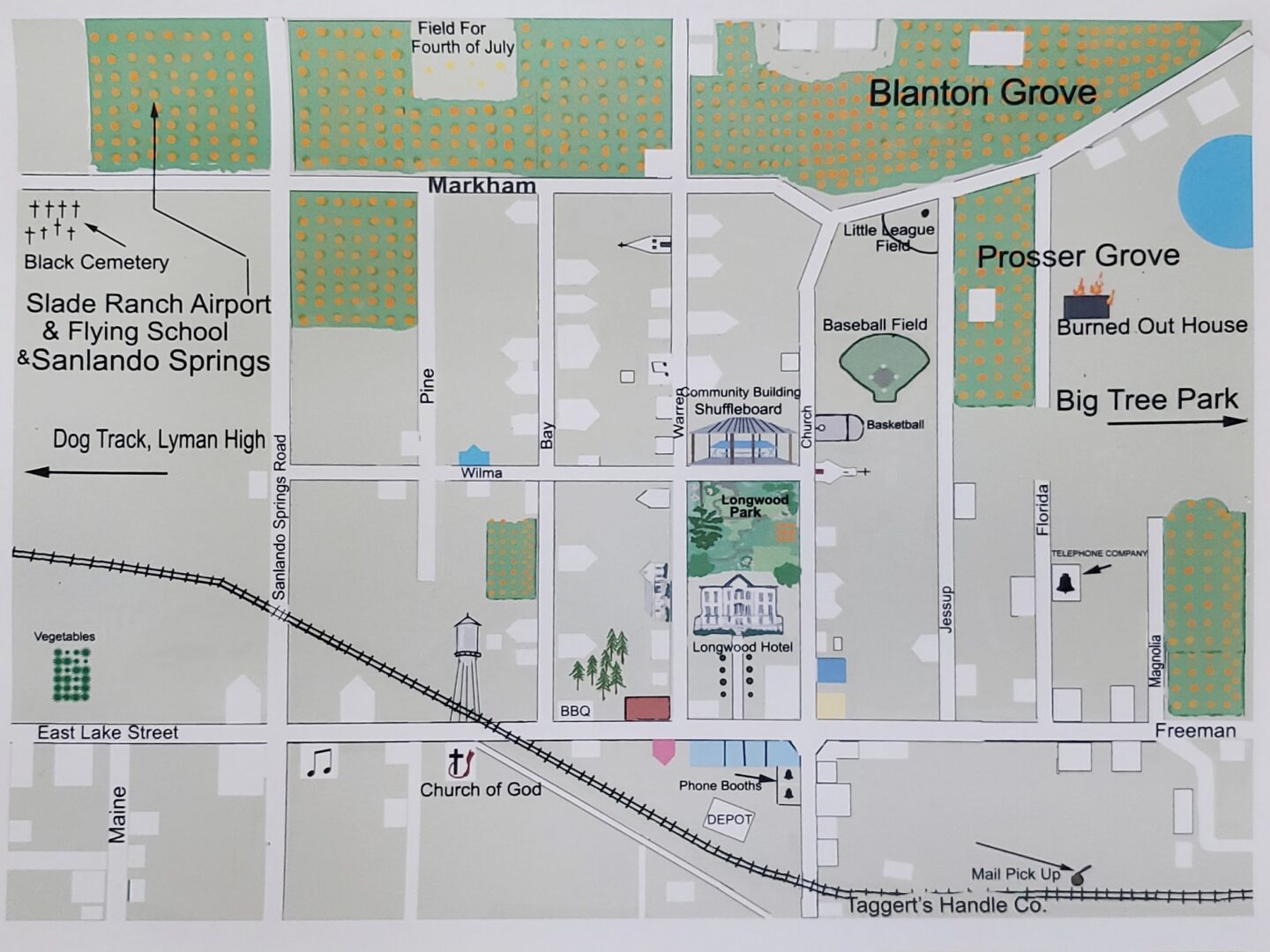
Needless to say, let’s get started. We’ve given you some handouts today, and one of the handouts is the picture of Longwood, the map, and I’m going to run down this map, and you’re gonna follow me along. I’m going to tell you what went on. Remember the time frame: it’s in the 50s, 60s, maybe some 40s, 30s, and 20s thrown in, and maybe some early 70s, but nothing has since.
All right, Longwood back in 1950s, 717 people. You see the hotel. Right across from the hotel, you see the outline of the building we’re currently in: the Longwood City Civic League. Specifically, as you know, it’s made of women, ladies that wanted to better this town. I’m happy to say my grandmother was one of the charter members of Longwood Civic League. When I was a child, you know you always snoop around old buildings and old places. My brother and I were snooping around this building and we always like to crawl under things, so we crawled under this building. Believe it or not, looking to the back, looking to the left-hand side, we found shutters. And there were wooden shutters, huge wooden shutters, so they had originally been placed on this building, big old brown shutters. I don’t know whatever happened to them. I told Pam we were talking about them that the shutters were under this building. I guess had been there for decades.
Moving on down you see again the City Hall, or the Civic League, and this is also where the library was. The library of course was coming here on the left-hand side and looking at, and they would say, just a little tiny library that you could go in and do research. They’ve had a ton of old encyclopedias. That was before computers, guys. So all we had were World Books and Encyclopedia Britannicas, and of course, ours were from the 20s and 30s. In Longwood, they worked, it was flourishing. Back in the back of the store was the stage, a big stage right back there. And it had doors on both sides; the kitchen went out to the porch. And I will tell you, when I graduated from kindergarten, I was on that stage there. And I had many a birthday party in this building here. So it shows you how old it is and that people still remember what it was like. Again, this building has been the city’s center for many years, we were proud of this building. The thing that worried most of the people, though, they didn’t like it when they shut off the doors and the prettiest doors out from the sides. I know my parents thought it ruined the building because they enclosed the porch. And I’m so glad that you folks took the time and effort to make it look like what it is today, thank you.
Area Businesses
All right, let’s go with Longwood now. We’re going to leave this building, it’s like we’re a walking tour. We’re going to leave this building, we’re going to go down here to 427 Ronald Reagan.
- [Kent House] The building next door to us was built in the 50s, it was Cunningham I believe home. This is where Kathy lived or her parents lived.
- [Clocktower Park] Next door to that was a big two-story 1920s, we call them boom time buildings. The boom time building was a two-story gray stucco building and that housed the Longwood laundry. Now we had our own laundry. People who actually used it and they had upstairs Apartments.
- Next door to that was a little restaurant. It was yellow but it was brick, they painted it over to brick, and it’s called Cozy Corner. And you’d go in there and you could get your breakfast, lunch, or dinner. And sometimes my brother and I were given money to go down there and have dinner.
- [Dixie Food Mart] Across from it was Johnson’s IGA or the Longwood Market. The Johnsons were wonderful people, Mr. and Miss Johnson and his son Buddy and his wife. They moved from North Carolina and they were instrumental in taking over making this grocery store. The store was developed by Mr. and Miss Hood who lived down the street. We’re proud because of a silly grocery store around. In fact, there was a Super Value. But other than that, that was the only grocery store unless you wanted to go to Maitland to the Winn-Dixie or the Winter Park or Sanford, and that was it.
- The market had a meat market which is very popular with the community and with other surrounding area. And Buddy and Mr. Johnson also went after we call them the dog people, the people that came in the winter to race dogs. We sold a lot of dog food, believe me. I had the opportunity, the pleasure to work for Mr. Johnson for about three years in my high school years and it was a lot of fun. I saw, I’ve met a lot of these people.
The Hotel Area and Warren Street
We’re gonna now follow through. And of course, between the Longwood Inn, which is all today we always call it a hotel, you had the yard at the hotel with the long sidewalk that went down to the highway.
- At the corner of Warren and 427 just over here, sat on the left-hand side a garage. It was a big old red tin building, it was called Inman’s Garage. And you would pull up under the shade, under the cover of the garage, if you want a gas. Later on, Mr. Inman was working, he quit the gas and it sold the mechanical parts.
- Directly in the back of the building was a junkyard. And when I say junkyard, I mean it’s for all the old parts, old cars were pulled in there. And Longwood complained, so Mr. Inman took tin siding, tin roofing, and built a fence around it. And it painted it silver. It looked really nice (sarcasm). My folks just about had a fit when that happened! (laughs) They had to be looking at old wrecked cars.
- Directly across the street from Inman’s and on the hotel property was a little restaurant we called it Mom’s Corner. It was a beer garden, a little beer restaurant.
- Attached to it was a barber shop. Barber shop only opened in the evenings because the barber worked in Orlando during the week.
- Surrounding this building, a little concrete building, was a growth of Australian pine trees, big Australian pines, beautiful trees. And as kids we’d get under these big Australian pines. If you’ve been to South Florida you know they’re every where down there. We had these beautiful trees around Longwood. A freeze in the late 50s killed them and of course, they had to cut them all down. So that was the end of our Australian pines.
Neighbors and The Niemeyer House
- In back of Inman’s, near the junkyard, was a little house and it was one of the original houses in Longwood. During the period of time I lived there, was a family called Brunell. The Brunells were from Maine. They would come down every year and stay the winter at this little home. They kept it very nice and very clean. The house actually sat on the sidewalk. it was really amazing, you had the stoop and then you walked into their house.
- In the years that they stayed, Mr. Brunell built an airplane (a Piper Cub) in the backyard. For us kids we thought that was really outstanding to see that.
- And the thing about Mrs. Brunell that was really interesting was that her niece was actress June Allyson. So we were always impressed with that, saying June Allysson lived here in our neighborhood.
- [Tunis Lewis House] Next door to the little place to eat was the DeRosa house. Roddy and Willie DeRosa, they had two children, Pat and Paul. Before that it was a rental. People would come and live there, mostly during the winter.
- [Beesley-Milwee House] Next to that was our home, the millinery place which currently stands.
- [Niemeyer House] Next to our place is a large lot and it’s still open. The large lot was the property of the Niemeyers. Mr. and Mrs. Niemeyer were lovely people. Their home was well taken care of. I’m so proud to say yes, as you all know that they’re redoing it, I believe, and I’m really thrilled to see that because it was a showplace in its day. They had a massive. yard running from our house to theirs.
- Mr. Niemeyer collected tropical plants and had every type of tree you could think of. We built a tree house in a tree called a Cuban apple. We had mulbeeries, we had every type of citrus you can think of.
- Midway in the property was a water tower, an old water tower. When we were kids we would play around it because we would look down the pipe and you could see the water way down there. One day we took a softball and dropped it down and it got stuck. So there went our softball. But anyway, there was a water tower that sat over there…
- We were also amazed because on the back porch facing our house was a sistern, well it was an old well. And they’d go from their kitchen to get water from their well. Their house was very well taken care of, it had a side and a great room and a living room and their bedrooms. It was beautiful.
- Interesting story: The day Mrs. Niemeyer died, I remember. Believe it or not, back then, when the hearst picked you up they wouldn’t bring you out in a bag of a coffin. This was in in a basket—it was like a long picnic basket, about the size of the table in here. I can remember them bringing Mrs. Niemeyer out in the basket and putting her in the hearst and driving off.
- My father bought the house after she died, made two apartments out of it. After that, he said he would never do another rental.
- After that, we were fortunate enough to sell it to a family called the Hopkins that came from Hoboken, New Jersey. The Hopkins had four boys and a girl. And they lived there all their lives, unfortunatley, I believe they are all gone.
The Park and Hotel Anecdotes
- [City Hall] Directly back in the hotel over here sat a park. The big park was what all the kids played in. There were no sidewalks in it, just trails and then a big open area in the park. In the Middle were swing sets and teeter-totters. Ther ewas also a grove. We had a grove over there along Warren Street, it planted azaleas and they even had a sprinkler system that when there was a drought they turned the sprinkler system on. We thought that was really neat. And they had at the entrance was one of the biggest pine I’ve ever seen. It was huge!
- Of course, the city took it over and built the City Hall and those other buildings, but anyway we did have a beautiful natural park in Longwood.
- [Longwood Inn] Going back to the hotel, living by the hotel all these years, believe me, this place looks a million times better than what it looked like back in the 40s, 50s, 60s. Being how it was kept up.
- Coming off the side of the hotel, by our home, was the kitchen. It has since been torn down.
- My grandmother told the story that during the 1920s, the Showgirls or Flappers would do their shows (at night) and then during the days they would crawl out on the second floor roof facing our home and sunbathe up there. Well, believe it or not, Longwood let them do it. They didn’t think anything of it. It was just girls trying to get a suntan, even during that period of time.
- Another interesting story about the hotel. In 1927, my mother’s 17th birthday, her father took her to the hotel for dinner. Also during that time, they had a jazz band. My mother said they happiest she ever was was when she danced the Charleston with her dad at this hotel.
- After dinner, her father let her go into a back room of the hotel where there were slot machines. Her father let her play the slots. Back when she was growing up in the 20s and 30s, there were slots everywhere in Longwood—the drugstore had slots, every bar had a slot. It was the thing that Longwood had during that period of time.
Church Street Businesses
Let’s go back to the intersection of Church Street and 427 down here. You see the little shopping area.
- [Henck-Tinker Building] Right across from the Longwood Market was Moon’s Department Store. It was a dry goods store. They carried everything you could possibly think of.
- The neat thing about this was that it had been the former Bank of Longwood during the 20s and 30s. But it went under before the Depression. In this building they had the vault. Believe it or not, if you wanted to try on clothes, you went into the vault to change your clothes. They had that big old door that would shut. Bill and Billy Moon were wonderful people. They lived out at the dogtrack. He had worked at Dick’s Department Store and then moved out here to Longwood to open Moon’s Dry Goods.
- Next door to Moon’s was the drugstore that was owned and run by Doctor McReynolds. He was an old gentleman so he couldn’t really fill the prescriptions. He had everything else that you wanted, everything from BC Powders to nose drops to dye gels. Lining the walls were cabinets with glass panes. If you wanted something from there, you’d ask Dr. McReynolds for an Alka-Seltzer.
- This little drugstore also had a marble soda fountain. And about four or five bistro tables and chairs, wrought iron. During the 40s and 30s, this is where the kids would go and get their milkshakes or the Cokes. During my time, he had gotten so old he couldn’t do it. But all of that equipment and furniture was still there. And I got so jealous beacuse I wanted to use that part of the drug store. The rest of the drug store had counters with candies and cigarettes and things like that.
- Next door to that was Hartley’s Feed Store, feed and fertilizer. We’d go there and buy our fertilizer for the yard and the citrus trees. Mr. Hartley had a little grocery store next to it. The store wasn’t open that much because spent most of his time hunting and fishing, so the store was not open that much. The people that really shopped there were the people that lived in North Longwood off of Myrtle Lake Hills. Just to show you how rural it was, they didn’t have electricity back then, we made fun of them because they lived way out in the sticks.
- Next door to that sat a candy store, a little ’20s/’30s-time building. A lady from Winter Park opened up a candy store. It wasn’t big but she made homemade chocolates there. Then there was an open lot, it’s still there.
- Then facing Warren Street was a two-story building on Madden’s Corner. It was a bar. Madden’s Corner was made out of cedar. You opened the door, and the bar ran down from the front of the building to the end of the buidling. It was huge! During the 40s they opened up a pool hall next to it. But I was too young to go there. It was not a restaurant, it was totally a bar. They had alcohol only.
Warren Street and The Tourist Club
We’re gonna go back down Warren Street. Now I’m looking west on Warren. At one time Warren Street was the way you got to Sanlando Springs. The road came up here to 434 and then turn itself to Sanlando Springs.
- Going down Warren Street, you had quite a few hones. The first one at the corner of Wilma and Warren, was a home where the Johns family lived. Currently, part of that home is what’s sitting up behind the police station [JD & NJ Lewis House]. I think they want to move it to the cemetery or something like that.
- Next door to that towards the square was the Wilson family. I loved these people. They were from the north. Mrs. Wilson had polio. They were an elderly couple, but she taught piano. Mr. Wilson was a contractor. They built the cottage, the garage apartment behind the home, as well as the one next to it. And it’s stands today. Then there was a lot.
- [Baptist Parsonage] Next to that was a lot, what is today a law office. But that was where Mrs. Mennick lived. She was a really cute. She was a little lady, no more than five foot, a widow. Friendliest lady you’d ever want to meet. And she’d walk to the post office every day, and she carried a purse this big. We never undertand why little Mrs. Mennick wouldn’t carry anything else. Always had this big purse!
- Then you have where Judy’s Dolls is. That general area was the Baptist Church. That was one of the few churches in Longwood, other than the Episcopal and later the Church of God.
- My mother told a story when they were having a revival at the Baptist Church. It was an old wooden church. The minister at the revival was speaking. As he was speaking, he had a gold tooth that popped out of the revivalist’s head and landed into the offertory. She said they sat there and started laughing. And the man was so embarassed he didn’t know what to do! But there was the tooth in the money bowl!
- [Clouser House] Then on the other side of Warren, is where the birthing center was. There lived an elderly lady and her name was Mrs. Thompson. We always called it Thompson House.
- [Clouser Cottage] Directly in back of her was where the Shaws lived. They had three children. We were very close with them. I think at one time, it was a gift shop an craft shop. And it’s still standing today.
The building that I was really impressed with as a child was directly across the street from the park, or what is now the city hall. [Ed Myers Recreation Building] And that was where the WPA in the 30s built a pavilion. A big pavilion over the floor, supported by a big cypress tree. They had huge tables built by the WPA. This is where so many activities took place, particularly every year the volunteer fire department had a chicken dinner. They also had WPA built-to restrooms and two great big stone grills.
- Longwood was noted for a shuffleboard court in the 50s. Nobody was allowed to walk on the courts because the Tourist Club had really put in some beautiful courts. The tourist club would meet every winter, and at times there were hundreds of people that would go down there and play shuffleboard.
- [Christ Episcopal Church] Directly across the street on Church Street you had the Episcopal church.
- [Peppermint Park] Next door was a basketball court for the kids and next to that was a baseball stadium.
- [Police Station] Going on down Church Street, we need to turn onto the Markham Woods or Markham Road. Back there was a Little League field.
- In the olden days the Citrus Grove’s always had a big old house usually in the center of the Grove for a caretaker.
- [Searcy House] Going on out you had the Searcy home. Mr. Searcy, my father took me as a little boy to visit him when he was dying. His home had a magnificent stairway. After he passed, Miss Searcy bought herself a VW. She would drive her VW into town every day. She liked to take a nap or two, and she’d ride into Longwood and take her little nap.
Hardware, Rail, and Final Landmarks
Going on back down to Church Street.
- Across from Moon’s and Post Corner sat Carhart’s Variety Store, our five and ten. My brother told me last night that when he was eight years of age, he wanted a BB gun. Miss Carhart made a deal: if he pays a quarter a week, they’ll sell the BB gun.
- [Payne Building] Next door was the little Panye Hardware. Mr. Payne ran it and lived above it. He had a big balcony out over Church Street, screened in, and he would sleep out there so he could see what was going on in Longwood.
- The big news was that one early morning this Penny got up early and looked out over toward the railroad track and he saw a flying saucer.
- Next door was a little store called Ted’s Appliances. Unfortunately, Ted was killed at the railroad track.
- The railroad had been moved about 50 yards from where it is now. They had a Depot with a big ramp, and as kids we’d play on the ramp with our bikes.
- Next door to Moon’s were two little rooms, about the size of a closet, where Winter Park Telephone put telephones which were available to the teenagers. Not everybody had phones, and if we did, it was all on party lines.
- Mrs. Penny also was the Postmistress of Longwood for over 50 years. Everybody went to the post office for the mail. She would put the outgoing mail in a big canvas bag and walk it down to the railroad, where the express came through (the Champion) and would rip off the mailbag on the train.
- [ACL Railroad] We had original SunRail here, believe it or not, 50 years before. The local ran from Sanford, Lake Mary, Longwood, Altamonte, Maitland, Winter Park, and downtown Orlando.
Going north 427:
- Past Jessamine Street where the Italian restaurant is, was the Purvis big Italian family.
- The next street was Florida Avenue where the Jacksons lived, and behind them, the Walkers.
- The Overstreet house and the Hunt house still stand.
- The Friedman house today is the law office. Poor Dan Friedman lived there, and unfortunately he killed himself.
Going toward Lyman from 434 Ronald Reagan:
- Inman’s garage. Next you see Barbecue, that was the Burmeister family. Before that it was called Loveless, a drive-in for teenagers. Before that it was a citrus stand.
- Across the street you had your water tower.
- [Longwood School] If you take a left on Wilma, you see the little blue building, and then it was the old Longwood City Hall and one-room school. My mother went to school there.
- The Pinches lived there. Mr. Pinch was a very unusual man. He wore a pith helmet, big old white shirt and big old khaki shorts down to his knees, and carried a staff. He had worked for the government, a Diplomat in China or India.
- Across the railroad was Silver Street house, built in the style of a 1900s prairie-style house.
- Across the street at the corner of 434 and 427 sat Jean’s [Jean], a big grocery and automobile service station.
- Across the street from this place was the Fidelity shop, where they would teach music classes. It was a 1920s Mission-style filling station.
- Across from Jean’s sat the Wales’ home. Mr. Wales was the first postmaster, she was the teacher.
- Maine Street was named because that’s where so many people from the north lived. They were wonderful winter residents (families from Ontario) and their coming down every winter boosted the population.
Closing Thoughts
- We had a home called Floras Slick. His wife and him were noted for their vegetable garden. Across 427 was a big open field where he grew winter and spring vegetables.
- You couldn’t go anywhere without smelling a citrus grove, particularly in February, March when they bloomed.
- Black Community: There were very few black families here. Mrs. Ziegler’s family lived down where Winn-Dixie is today. Elijah Sigler drove a tractor every day into town with a cart. There was also Stella (Fleece) and her family, and Coral Marie who lived in a shack where the current McDonald’s is.
- Black Cemetery: When they built the former Pick-n-Save, there was a black Cemetery back in there. During the time of construction, they found bones, but they didn’t stop Longwood; they just went on and built over.
- Another big black family was the Jones family, a very well-to-do family that kept the groves and had groves of their own.
- The most exciting thing that happened was about 1960 when Hurricane Donna came through and really tore the place up. School was out for about three weeks. Longwood was high and dry but had no electricity.
- The reason they had electricity is they were aligned with Johnson’s store, and they kept the frozen food building for people.
I’ve more or less taken you around a little Longwood and tried to give you a little bit about the folks that lived here. Kathy’s going to pick it up and tell you about the rest of Longwood, down to Lyman and the old Longwood High School. Thank you. [Kathleen Kent continued from here…]